
Trustwelt AI Security · Workspaces and network
One folder to write, named places to read, one way out.
An agent that may read the whole home folder and reach the whole internet is a copy machine with good manners. Started through Trustwelt, the agent is held to the workspace it was started in, to the toolchains it needs, and to the connections your rules allow, with Trustwelt putting in the credential a destination needs so the agent never holds one.
A module of Trustwelt AI Security, included with it. Runs on: Managed computers with Trustwelt Desktop and its browser extension: the Chromium family and Firefox on Linux, Firefox on Windows; the AI agent gateway on managed Linux computers; other programs through the network filter, sites only.
What it does
Workspaces and network, in plain words.
- Write
The workspace, and a private temp folder
Writes go to the folder the agent was started in; nothing else is writable. Extra folders can be added read-only or writable; the .git folder can be read-only.
- Read
Toolchains, not the home
The system and language toolchains the policy lists are readable; the rest of the home folder is not. Browser profiles, the vault and credential files stay out whatever the list says.
- Connect
Through Trustwelt only
Connections leave through the gateway's proxy, by category (model providers, git hosts, package registries, cloud APIs, internal, other) and by named host: allow, record, ask or refuse. The cloud metadata address is refused.
- Credentials
Put in per destination
For hosts you name, the gateway ends TLS with a device CA trusted only by agent processes and adds the credential from the vault: a bearer token for an API, basic auth for git over HTTPS. Pinned destinations pass through untouched.
- SSH and git
Keys the vault signs
An SSH agent of Trustwelt's answers the agent's ssh and git with keys the vault signs on the computer; the private key never leaves the vault service. The person's own terminal can use the same agent for their own keys.
- MCP
Servers started through the gateway
Registered MCP servers are started in the same box through Trustwelt's MCP gateway; a tool whose description changed since the organisation approved it is held, and only the registered program runs under a server's name.
How it works
From the console to the computer.
Set the room
Agent rules › Workspaces and network: where an agent may write and read, the toolchains, the categories and hosts, which hosts get a credential and from which vault item kind.
Start through Trustwelt
Trustwelt Desktop › AI agents › Start an agent in a workspace gives the one line to run; the agent starts inside bubblewrap and Landlock with its network forced through the gateway.
Decide connections
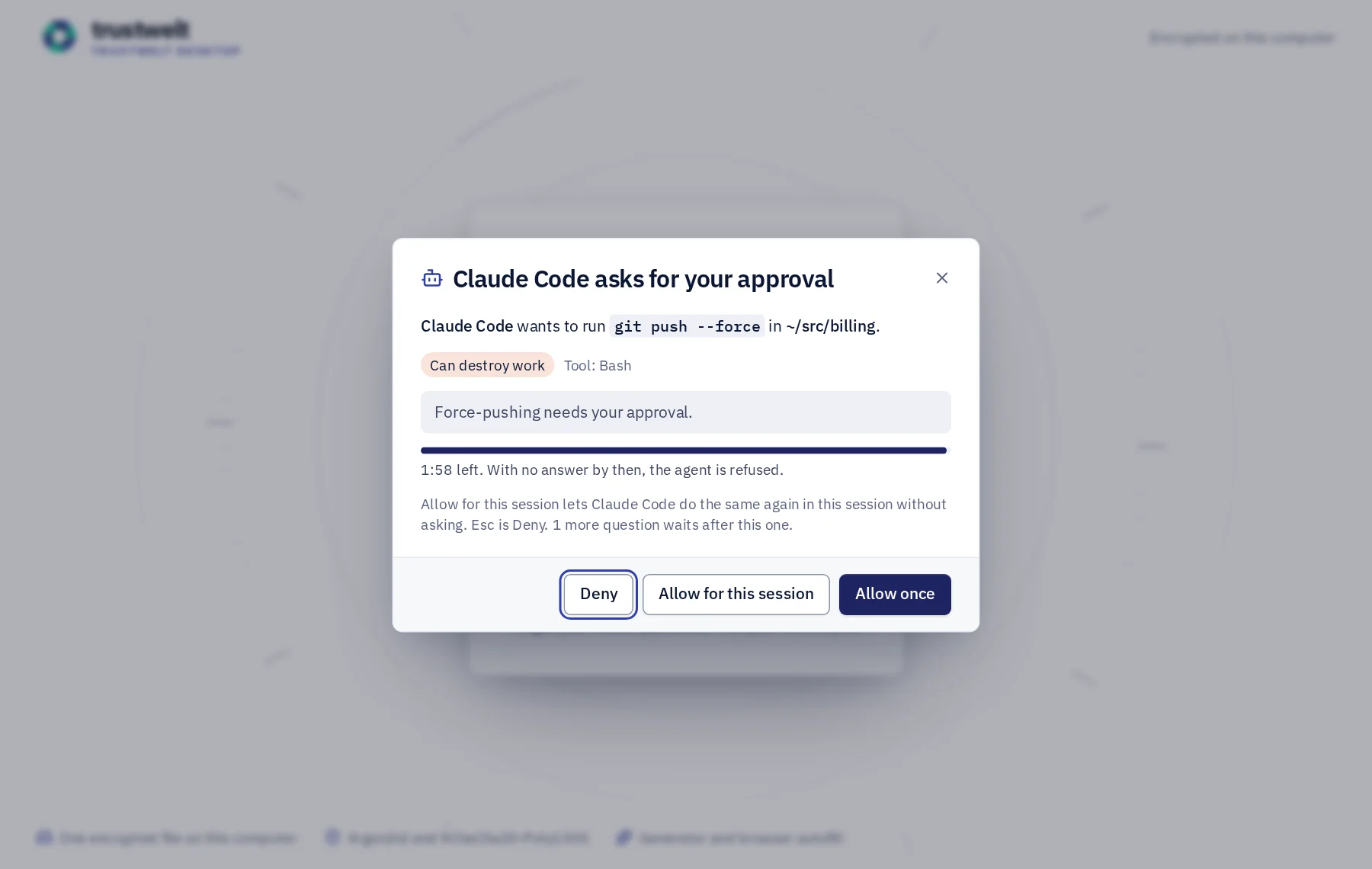
A destination the rules ask about raises the same question in Trustwelt Desktop as a tool call; refusals and injected credentials show in the session.
See how each session ran
Per session: confined, governed or seen only, the mechanism, the connections by host and category, bytes in and out, and what was refused.
In Tenant Admin
What your administrators see.
What is recorded, and what never is
Your organisation sees this. Nothing else.
- ConnectionsHost and category, connections, bytes in and out, the decision, and whether a credential was put in.
- How it ranConfined by Trustwelt with its mechanism, governed by its settings and hooks, or seen only; whether its network was forced through the gateway.
Never:
- The content of a connection: the proxy decides the host and counts the bytes.
- A credential visible to the agent: it is added by the gateway on the computer after the agent's request leaves the box.
- A host trusted on first sight for SSH: the person's known hosts decide, and an unknown host is refused as SSH refuses it.
Specification
Where it runs and how it is sold.
- Runs on
- Managed Linux computers with the current Trustwelt Desktop: bubblewrap and Landlock for the box, the gateway's proxy for the network.
- Agents started this way
- Claude Code, Codex CLI, Gemini CLI, or any command you name; MCP servers through the MCP gateway.
- Credential schemes
- Bearer and custom header schemes for APIs; basic auth for git over HTTPS (GitHub, GitLab); SSH keys signed in the vault for git over SSH.
- Sold as
- Part of Trustwelt AI Security.
Questions
Asked before buying.
- Can the agent still install packages and run tests?
- Yes. Package registries are a category of their own in the network rules, the toolchains are readable, and the workspace is writable; the test run shows in the session as an allowed, recorded call.
- What about an agent started outside Trustwelt?
- Its hooks still reach the gateway, so its tool calls are decided and recorded, and its session shows as governed rather than confined. Coverage shows the difference.
More in Trustwelt AI Security
The other modules, and what works with this one.
- Trustwelt AI Security
Agent gateway
About Agent gateway about Agent gatewayEach tool call of Claude Code, Codex, Copilot, Cursor and Gemini CLI decided on the computer: allow, ask or refuse.
- Trustwelt AI Security
Model gateway and keys
About Model gateway and keys about Model gateway and keysModel calls through a gateway on the computer: your providers, one data gate, keys the agent never sees.
- Trustwelt Vault
Company servers
About Company servers about Company serversSSH keys for company servers, used from people's terminals and AI agents without being handed over.
- Trustwelt AI Security
AI services and categories
About AI services and categories about AI services and categoriesThe AI and language services Trustwelt knows, each approved, restricted, blocked or left open.
- Trustwelt AI Security
What goes into AI services
About What goes into AI services about What goes into AI servicesWhat is pasted, dropped, uploaded or sent is checked on the computer before the site gets it.
- Trustwelt AI Security
Policies
About Policies about PoliciesWho may send what to which service: drafted, simulated, published, versioned.
Start with Trustwelt AI Security.
Workspaces and network comes with Trustwelt AI Security, sold on its own per person per month. An organisation account is free.