
Trustwelt AI Security · Agent gateway
An agent does what it is allowed to do. Each step is decided on the computer.
Claude Code, Codex CLI, GitHub Copilot, Cursor and Gemini CLI call their hooks before and after each tool they use. On a managed computer the hook is Trustwelt's: the call reaches a small gateway next to Trustwelt Desktop, which decides in well under a millisecond and writes a record. The agent sees the decision; the person sees the questions; the organisation sees the sessions.
A module of Trustwelt AI Security, included with it. Runs on: Managed computers with Trustwelt Desktop and its browser extension: the Chromium family and Firefox on Linux, Firefox on Windows; the AI agent gateway on managed Linux computers; other programs through the network filter, sites only.
What it does
Agent gateway, in plain words.
- Tiers
Five kinds of call
Read, write, execute, destructive and exfiltration. A shell command is split into its simple commands and raised by what it does; a write outside the workspace the agent was started in is destructive.
- Rules
First match decides
Rules on a tool, a command pattern or a tier: allow, allow and record, ask the person, or refuse, each with words the person reads. A question waits a set time; with no answer, the call is refused.
- Folders
Guardrails no rule loosens
The agent's file tools may not read ~/.ssh, ~/.aws, ~/.config/gcloud, ~/.kube, browser profiles, the vault or other agents' credential files, and may not change its own settings files or git hooks.
- Unknown agents
Recorded or refused
A program Trustwelt does not know is recorded or refused by your choice. Permission-bypass modes of the known agents are refused above a read while they are disabled.
- Output
Secrets masked on the way back
What a tool returns to the agent is read for private keys, API tokens and passwords, and those are masked before the agent sees them.
- Managed settings
Written by Trustwelt, repaired if edited
Each allowed agent's managed settings, hooks included, are written by Trustwelt's root helper and written again when found missing or edited; the state shows per agent in Agent analysis.
How it works
From the console to the computer.
Publish the rules
Tenant Admin › AI services › Agent rules: write the rules, test them against a sample call, then publish; every version kept, any earlier one published again; exceptions per person or group.
Delivered in the signed state
The rules reach each managed computer inside the signed web state, cut per person; the gateway reads them and compiles them once.
Decided per call
Before each tool call the hook asks the gateway; a question goes to the window of Trustwelt Desktop that started the agent, with Deny, Allow once and Allow for this session.
On record
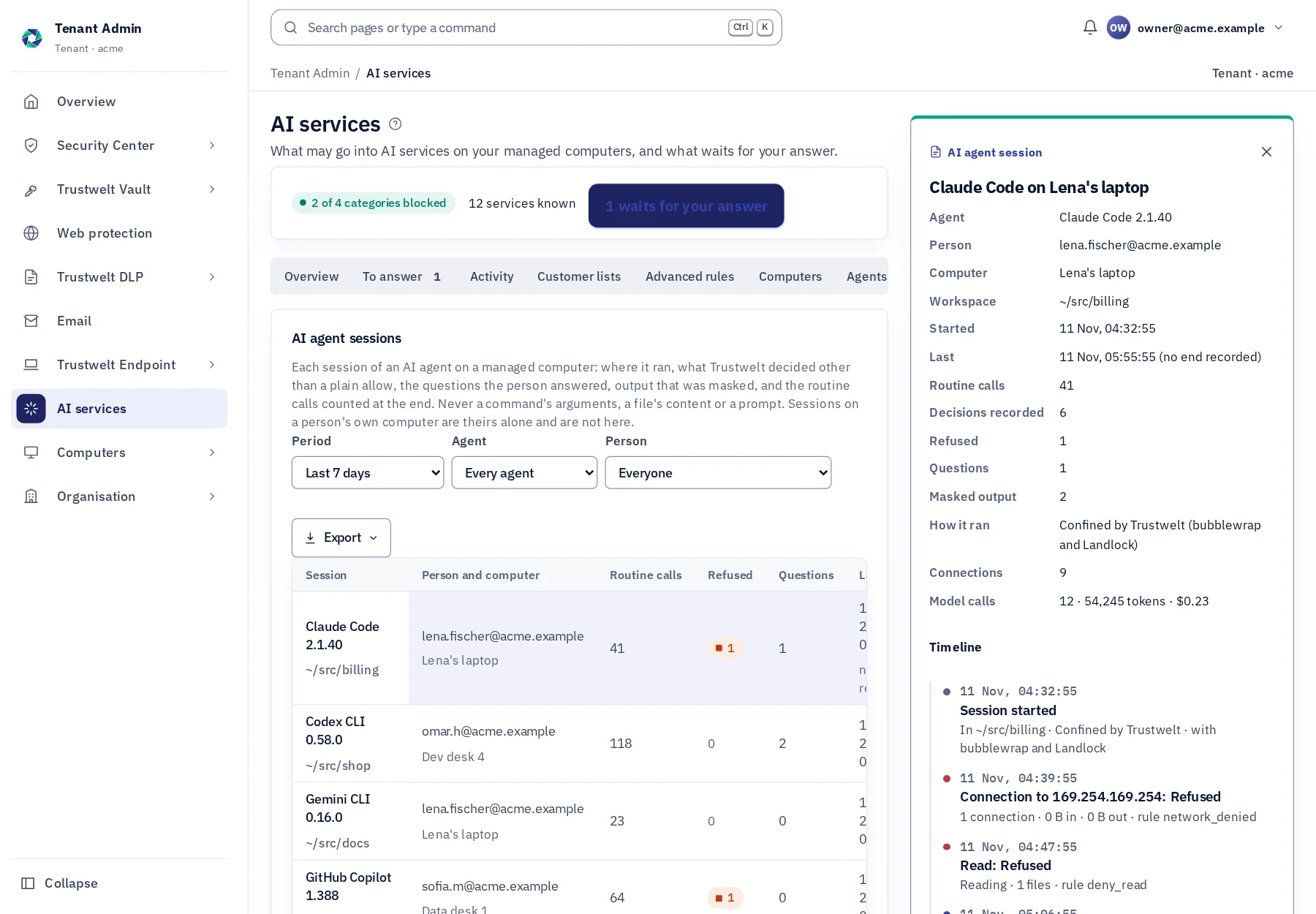
Sessions in Tenant Admin and in the person's Portal: each decision that was not a plain allow, the questions and answers, output masked, routine calls counted; CSV and PDF.
In Tenant Admin
What your administrators see.
What is recorded, and what never is
Your organisation sees this. Nothing else.
- DecisionsThe tool, the kind of command in two words, the tier, the rule that decided, the decision, and for a question who answered and how.
- SessionsThe agent and its version, the workspace, start and end, counts per tool, whether the hook could reach Trustwelt Desktop.
Never:
- A command's arguments, a file's content, a prompt or a tool's result: the record keeps the kind of command, never its text.
- A decision taken by the browser or the agent: the gateway on the computer decides, from the signed rules.
- A remote shell or a script run on the computer by Trustwelt.
Specification
Where it runs and how it is sold.
- Runs on
- Managed Linux computers with the current Trustwelt Desktop. The person's own computer: the same gateway, with the person as its administrator, from their Portal.
- Agents governed
- Claude Code, Codex CLI, GitHub Copilot (VS Code and CLI), Cursor, Gemini CLI; any other agent by the unknown-agents rule, the sandbox and the network rules.
- Decision time
- Measured on the computer: a decision in tens of microseconds, the hook's round trip in a few milliseconds.
- Sold as
- Part of Trustwelt AI Security.
Questions
Asked before buying.
- Does this slow the agent down?
- A decision takes tens of microseconds; the hook's whole round trip a few milliseconds. Routine allowed calls are counted per session rather than written one by one.
- What if Trustwelt Desktop is not running?
- Reads go on; anything above a read is refused with the message "Trustwelt Desktop is not running", and the miss is recorded and shown in Tenant Admin.
- Can a person approve a company credential?
- No. The person answers for their own workspaces and personal items; company credentials and production destinations follow the organisation's rules.
More in Trustwelt AI Security
The other modules, and what works with this one.
- Trustwelt AI Security
Workspaces and network
About Workspaces and network about Workspaces and networkA confined agent writes one folder, reads the toolchains and connects only through Trustwelt.
- Trustwelt AI Security
Model gateway and keys
About Model gateway and keys about Model gateway and keysModel calls through a gateway on the computer: your providers, one data gate, keys the agent never sees.
- Trustwelt AI Security
AI agents on the computers
About AI agents on the computers about AI agents on the computersWhich agents and MCP servers each computer holds, and which keys lie in files they can read.
- Trustwelt AI Security
AI services and categories
About AI services and categories about AI services and categoriesThe AI and language services Trustwelt knows, each approved, restricted, blocked or left open.
- Trustwelt AI Security
What goes into AI services
About What goes into AI services about What goes into AI servicesWhat is pasted, dropped, uploaded or sent is checked on the computer before the site gets it.
- Trustwelt AI Security
Policies
About Policies about PoliciesWho may send what to which service: drafted, simulated, published, versioned.
Start with Trustwelt AI Security.
Agent gateway comes with Trustwelt AI Security, sold on its own per person per month. An organisation account is free.